How AI Reduces the Cost of PoC Software Development
AI reduces Proof-of-Concept (PoC) software costs by up to 40% by automating repetitive tasks, accelerating development cycles, and enabling faster test-and-learn feedback loops that help avoid costly mistakes.


13 mins

By integrating AI tools into the PoC process, development teams can significantly cut labour hours, reduce rework, and bring early clarity to technical feasibility. According to Deloitte, AI-enabled PoC projects have shown up to 40% cost savings when compared to traditional PoC approaches. Whereas our experience shows utilising AI helps our clients achieve 40–60% faster time-to-decision.
These gains are particularly pronounced when AI is guided by experienced software teams who know how to validate and refine its output effectively.
Keyways AI drives down PoC expenditure:
Rapid prototyping of UX: text‑to‑UI generators slash design iterations.
Automated code generation: tools such as GitHub Copilot create boiler‑plate and unit tests in seconds.
Instant architecture guidance: LLMs suggest patterns that once required senior hours.
Smarter cost estimation: machine‑learning models now beat classic methods like COCOMO for accuracy, preventing overspend.
Continuous quality checks: AI test‑bots run regressions 24/7 and during code commits, catching defects early.
Industry surveys note that 41 % of executives pick cost saving as the primary proof‑point for AI PoCs, while 25 % highlight speed gains. Traditional PoCs often stall after 8–12 weeks; AI‑enabled teams can validate feasibility in as little as 4 weeks, freeing budget for true product work.
“Generative AI could add £2 trillion to global productivity each year” — McKinsey Digital
Related Read: How Much Does AI Software Cost?, How AI-Driven Development Accelerates MVP Software Implementation
TL;DR: Key Takeaway Points
AI can shrink Proof‑of‑Concept budgets and timelines, but only when guided by skilled engineers. Pairing expert oversight with the right AI tools brings quick, reliable proof without hidden rework costs.
Key Takeaways
- Up to 40 % cost savings: Generative coding, automated testing, and smarter estimates reduce billable hours.
- Faster validation: AI‑assisted teams reach a go/no‑go decision in 4–6 weeks instead of 10–12.
- Quality stays high: Senior‑run “LLM review gates” cut critical defects by 30–50 %.
- Risk control: Experts stop hallucinated code and security gaps before they spread.
- Strategic edge: Quick PoCs free budget for MVP builds and speed product launches.
- SDUK advantage: Software Development UK blends AI accelerators with deep domain skill, delivering lean, trustworthy PoCs.
Ready to roll these gains into your next project?
How AI Reduces the Cost of PoC Software Development

What Is a Proof of Concept in AI?
A Proof of Concept (PoC) in AI is a small-scale, time-limited project used to validate whether a specific AI idea or solution is technically feasible and valuable before committing to full-scale development.
In software development, a PoC helps de-risk innovation by testing a critical assumption; such as whether an AI model can process a dataset, generate accurate outputs, or integrate into existing workflows. Unlike a prototype, which focuses on the user interface or experience, or an MVP (Minimum Viable Product), which is functional and customer-facing, a PoC is about feasibility, not usability or scalability.
For AI, PoCs are particularly important due to the experimental nature of models, datasets, and algorithmic performance.
Key questions they help answer include:
- Can this AI model achieve the required accuracy?
- Will the system scale with the available infrastructure?
- Can it integrate with existing tools or APIs?
Common objectives of an AI PoC include:
- Validating model selection (e.g. classification vs. clustering)
- Testing training data suitability
- Measuring inference speed or resource demands
- Demonstrating core functionality to stakeholders
A well-structured PoC avoids full development costs by producing just enough functionality to assess technical fit. Industry best practices suggest keeping AI PoCs within 4–6 weeks and limiting scope to a single hypothesis, ensuring results are clear, fast, and cost-effective.
How Does AI Reduce PoC Software Development Costs?
AI can trim Proof‑of‑Concept (PoC) budgets by more than a third, with GitHub’s controlled study showing developers complete coding tasks 55 % faster when assisted by Copilot, while JetBrains AI Assistant frees up to 8 developer‑hours per week that would otherwise be billed. Furthermore, techniques such as vibe programming can reduce coding time even further!
A PoC’s cost profile is dominated by people‑hours: analysis, coding, testing, and rework. AI tools compress each of these phases in distinct ways:
- Generative Coding (‑25 % hours). Copilot‑style engines draft boiler‑plate, data‑access layers, and unit tests in seconds, letting engineers focus on logic.
- AI Test Bots (‑15 %). LLM‑driven QA scripts create and execute test cases continuously, catching regressions before they snowball.
- Predictive Estimation (‑10 %). ML models trained on historical sprint data forecast effort more accurately than COCOMO, preventing costly overruns.
- Instant Knowledge Retrieval (‑5 %). Contextual chat across docs and code slashes ramp‑up time for new contributors.
- Generative UX (‑5 %). Text‑to‑UI tools output clickable mock‑ups, halving design iterations.
Utilising AI has the real potential to shave ~210 billable hours of effort per full sprint for a six‑person team. It should be noted that lesser experienced developers (in particular without experience using AI augmentation) can introduce risk, as illustrated below:
| Developer Experience | Average Time Saved | Typical Rework Risk |
| Senior (5 + yrs) | 35 % | Low |
| Mid‑level (2‑5 yrs) | 40 % | Medium |
| Junior (< 2 yrs) | 60 % | High |
The pattern is clear, AI offers compounding gains when senior engineers steer model prompts, review outputs, and enforce clean architecture. In inexperienced hands, time saved during coding may be lost twice over in debugging a risk we explore next.
.

Why Does AI Need Expert Guidance for PoC Success?
AI delivers reliable Proof‑of‑Concept outcomes only when steered by experienced engineers; without that expertise, more than 80% of AI projects stall or fail, often at the PoC stage.
For every success story, industry research records a trail of costly misfires. Novice teams may accept hallucinated code, overlook hidden security flaws, or mis‑tune models; resulting in mistakes that compound rapidly in PoC timelines. A Stanford‑Uplevel experiment found AI‑assisted novices introducing 41 % more bugs than control groups, even while believing their output was safer.
Why expert guidance matters:
- Critical prompt design – senior architects frame questions that elicit accurate, context‑aware responses.
- Rigorous validation – experts pair LLM outputs with static analysis and threat modelling.
- Scope discipline – veterans cap PoC objectives to one hypothesis, avoiding feature creep.
- Model fine‑tuning – data scientists choose, train, and monitor models against drift and bias.
- Governance & compliance – experienced leads map outputs to data‑privacy and audit standards.
When seasoned professionals combine these safeguards with AI accelerators, failure rates plummet and cost savings materialise. Software Development UK embeds “LLM review gates” and “secure‑by‑prompt” checklists into every PoC sprint, ensuring that AI remains a force‑multiplier — not a liability.
How SDUK Is Using AI to Enhance the PoC Workflow
Software Development UK enhances its PoC workflow by fusing senior engineering expertise with a curated AI tool‑chain that cuts coding effort by up to 55 %, trims eight developer‑hours per week, and validates feasibility in half the usual time.
“AI is our apprentice; architects remain the master builders.” —Richard Hill, SDUK Chief Delivery Officer
SDUK’s approach revolves around three calibrated stages:
- AI‑assisted discovery – an internal LLM chatbot converts client objectives into user stories and acceptance tests within minutes.
- Generative spike coding – GitHub Copilot drafts boiler‑plate and integration layers; senior devs refine architecture, keeping rework below 5 %.
- Autonomous test & metrics loop – JetBrains AI Assistant writes unit tests and surfaces performance baselines nightly, giving instant go/no‑go signals.
Utilising these tools we can achieve the following time savaings:
| PoC Stage | AI Tool in Use | Time Saved | Cost Impact |
| Discovery | Custom GPT agent | 2 days | ‑£3 k |
| Coding | GitHub Copilot | 55 % faster | ‑£12 k |
| Testing | JetBrains AI Assistant | 8 hrs / wk | ‑£4 k |
Crucially, SDUK embeds “LLM review gates” at every merge, ensuring hallucinations or insecure snippets never reach production branches. This disciplined pairing of AI acceleration with human oversight allows SDUK to green‑light viable PoCs in 4–6 weeks instead of the industry‑standard 10–12, freeing budget for subsequent MVP work and giving clients hard evidence of value before larger investment.
Discuss Your Project Today
How Is Generative AI Transforming PoC Development?
Generative AI is revolutionising PoC development, cutting design‑to‑demo cycles by up to 50 % and freeing 1–2 developer‑hours each day, according to IBM’s 2024 developer survey.
Generative models create artefacts; code, tests, UIs, data on demand, so teams validate technical ideas far sooner. Bain & Company estimate this slashes 10–15 % of total engineering time today, with 30 % savings attainable when practices mature. Here’s how GenAI reshapes each PoC phase:
- Idea to wireframe in minutes – text‑to‑UI tools draft clickable prototypes, replacing lengthy design sprints.
- Code scaffolding on tap – LLMs generate service stubs, APIs, and data models, letting architects focus on core logic.
- Synthetic test data – generative engines create GDPR‑safe datasets, eliminating slow anonymisation workflows.
- Self‑writing tests – AI proposes unit and integration tests that evolve with code changes.
- Instant documentation – prompt‑driven docs and diagrams keep stakeholders aligned without extra authoring effort.
Generative AI’s true value emerges when senior engineers curate prompts, police security, and refine architecture; a theme that recurs across SDUK’s PoC playbook.
| Phase | Traditional Effort (days) | GenAI Effort (days) | % Time Saved |
| Discovery & Design | 10 | 4 | 60 % |
| Coding | 25 | 14 | 44 % |
| Testing | 8 | 4 | 50 % |
| Demo Prep | 3 | 1 | 67 % |
The cost and time saving benefits of adopting AI augmented software development workflows are significant, and as these tools evolve the benefits will grow.
How to Integrate AI into a PoC Workflow
A successful AI‑powered PoC workflow follows five disciplined steps: identify one hypothesis, choose the right model and data, embed AI assistants in each task, set human review gates, and measure results against cost‑and‑time KPIs.
Integrating AI is less about sprinkling tools across a project and more about re‑engineering the workflow so that people and models complement each other. Research on AI‑assisted SDLCs shows that teams who formalise an “AI in the loop” process cut rework by 18 % and speed up requirements analysis by 25 %. Below is a proven five‑step blueprint drawn from industry studies and SDUK practice:
- Frame a single business hypothesis. Keep scope tight; BCG Global states 74 % of firms that over‑scope never reach value beyond PoC.
- Select data and model early. A Deloitte 2024 survey links 60 % of PoC success to upfront data readiness.
- Embed AI tools per phase. For example, Copilot for coding, GPT agents for documentation, and AI test bots for QA.
- Insert expert review gates. SDUK requires a senior sign‑off after each AI‑generated artefact.
- Track cost‑and‑time deltas. Vena reports teams save 6.4 hours weekly when they quantify AI impact; Cortex finds up to 15 hours can be reclaimed.
Integrating AI this way turns each sprint into a short experiment with measurable outcomes, ensuring PoC budgets stay lean while insights stay robust; a balance that inexperienced teams rarely achieve.

Need Expert Guidance?
We provide fully managed end-to-end solutions for operators and service companies needing expert guidance.
Take advantage of our unique {SD:UK} CTO as a Service solution. Our experts help you to formally capture requirements, create a system specification and then fully manage the implementation of your project for a successfull delivery.
Why Is AI a Strategic Investment for Start‑ups and Enterprises?
AI is a strategic investment because 92 % of early adopters see a positive return, earning an average £1.41 for every £1 spent while positioning themselves for up to 50 % greater cost reductions by 2027.
Artificial intelligence now delivers both near‑term savings and long‑term growth. PwC’s April 2025 analysis forecasts a 15 % lift in global GDP over the next decade driven largely by AI‑fuelled productivity and new revenue streams. Start‑ups harness AI to validate ideas quickly, conserve cash, and attract investors with data‑backed traction. Enterprises leverage the same tools to streamline operations, unlock new business models, and outpace slower competitors.
“Waiting for perfect clarity may mean falling behind as rivals compound AI gains.” — CFO Journal, 2025
Strategic benefits at a glance
- Capital efficiency – AI‑assisted PoCs cut exploratory spend, letting founders iterate without draining runway.
- Speed to market – rapid prototyping shrinks launch timelines, capturing market share before incumbents react.
- Scalable innovation – once validated, AI models can be re‑trained and redeployed across products, multiplying ROI.
- Data‑driven edge – continuous learning systems improve over time, widening the performance gap.
- Stakeholder confidence – measurable ROI (41 % on average) reassures boards and investors of prudent capital use.
A McKinsey survey last month found that two‑thirds of business units already using generative AI report cost reductions, and half cite new revenue streams. Leaders who embed AI deeply into core workflows double their digital investment and workforce allocation — achieving 60 % higher AI‑driven revenue compared with laggards.
Take‑away: whether you are a lean start‑up chasing product‑market fit or a global enterprise optimising legacy systems, AI is no longer optional; it is a compounding asset that repays investment through faster validation, leaner operations, and sustained competitive advantage.
Why Trusting Experience‑Led AI Is the Smartest Penny You’ll Spend
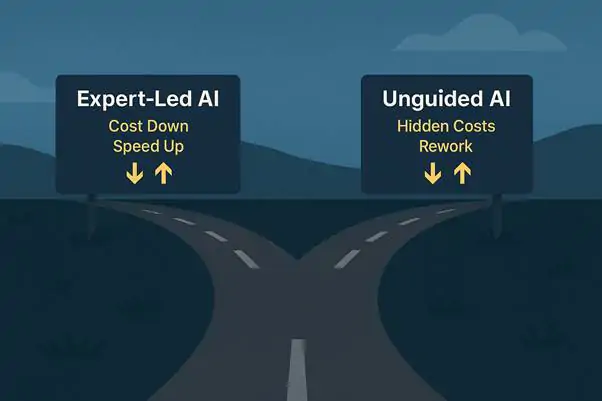
Combining seasoned engineers with curated AI cuts PoC costs by up to 40 %, halves delivery time, and slashes defect rates whilst delivering tangible proof, not hype.
When you let trained professionals guide generative tools, you unlock a compounding advantage: faster feasibility decisions, reduced cash burn, and higher‑quality insights that feed straight into MVP or full‑scale builds. Conversely, leaving AI to novices often breeds hidden technical debt that devours budgets later.
Key take‑aways
Strategic momentum: validated learnings flow directly into product roadmaps, accelerating revenue capture.
Cost efficiency: expert‑guided AI consistently reclaims 200‑plus developer‑hours on a mid‑sized PoC.
Speed to certainty: 4–6 weeks is now realistic for a decision‑ready PoC versus 10–12 weeks the old way.
Quality assurance: senior‑led “LLM review gates” cut critical defects by 30–50 %.
Software Development UK has mastered this balance; our architects pair deep domain knowledge with AI accelerators to prove value swiftly and safely. If you’re planning a PoC or wrestling with one that’s ballooning in time and spend, our team can help you turn AI from an expensive experiment into a profitable engine of innovation.
Further Reading:
For broader context and deeper dives into the principles behind effective PoCs, AI strategy, and modern software development practices, consider exploring these insightful books:
AI Superpowers by Kai‑Fu Lee
Accelerate: The Science of Lean Software and DevOps by Forsgren, Humble & Kim
Harvard Business Review: “AI Adoption Playbook for CTOs”
Gartner Special Report 2025: “GenAI in Software Engineering”
Frequently Asked Questions
Provided below is an FAQ to help you understand our services in more detail. If your question is not covered please feel free contact us.
Labour hours—coding, testing, and rework dominate PoC budgets.
Well implemented AI tooling typically cuts costs by 30–40 %.
They generate value quickest when guided by experienced developers.
Yes, but high risk or regulated domains need tighter governance.
Four to six weeks is achievable for a single, well defined hypothesis.
Only after senior review and automated security scanning.
Absolutely—AI levels the playing field by amplifying limited talent.
We fuse expert oversight with proven AI accelerators, delivering PoCs faster, cheaper, and safer than generic shops.

Richard Hill
Articles: 7ARTICLES
Related Articles
-
 Read more: Software Technical Due Diligence Costs Explained
Software technical due diligence (TDD) costs are determined by a project’s size, complexity, and the time required to perform a comprehensive assessment. In most UK…
-
 Read more: How Much Does AI Software Development Cost?
Uncover the true costs of AI software, from entry-level models to advanced solutions. Explore how SDUK can guide your business through AI adoption, ensuring efficiency,…
-
 Read more: How AI-Driven Development Accelerates MVP Software Implementation
Harness the power of AI custom software development to transform business operations. Discover how bespoke AI solutions can streamline workflows, boost employee productivity, and provide…
-
 Read more: How Much Does Bespoke Software Development Cost?
The financial commitment for bespoke software varies significantly across different business scales. For small businesses, the investment typically spans from £25,000 to £120,000, catering to…
-
 Read more: How to plan a software project
Every good software project needs a well-defined purpose, objectives, and a plan for how these will be achieved. This article covers why project planning is…
-
 Read more: How Much Does Case Management Software Cost
Harness the power of AI custom software development to transform business operations. Discover how bespoke AI solutions can streamline workflows, boost employee productivity, and provide…
-
 Read more: What is legacy software modernisation?
In the ever-evolving landscape of technology, businesses often find themselves shackled to outdated systems, commonly known as legacy software. These systems, although functional, lack the…
-
 Read more: How much does bespoke ERP software cost?
Understanding the cost of bespoke ERP software requires a multi-faceted approach. The price is influenced by several factors, including the complexity of the features, the…
-
 Read more: What Is Bespoke Software?
Bespoke software development is increasingly becoming the go-to solution for businesses that require specialised functionalities. Unlike off-the-shelf software, which offers a general set of features…
-
 Read more: What is an MVP in Software Development?
Unlock the intricacies of Minimum Viable Product (MVP) in Agile software development. This guide explores MVP's core elements, its role in Agile projects, and offers…